
Leaving New England, we drive about 4 hours along the New England Highway to Hunter Valley, the largest grape growing and winemaking area in New South Wales. Another route is to return to Forster on Highway 1 along Thunderbolts Way, which takes about the same amount of time. Today I will first introduce the Horse Capital of Australia, Scone, and other tourist attractions along the New England Highway.
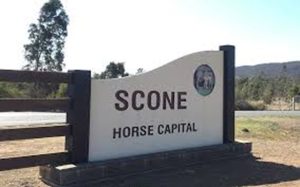

Scone, 130 kilometres from Tamwood, is an important rural town on the New England Highway. It is known as the "Horse Capital of Australia" and claims to be the second largest horse breeding area in the world, second only to Kentucky in the United States. Horsetown’s focus is reflected in many ways: it’s home to the Australian Horse Training Association; the world’s second-largest Hunter thoroughbred breeding region, with some of the country’s longest-established pony clubs; there’s a thriving polo and hockey community; and Gabriel Sterk’s bronze sculpture Scone Mare and Foal sits prominently alongside the highway at Elizabeth Park. The area is also home to cattle and sheep grazing, cereal farming, dairy farms and boutique wineries. The town and region has many important historical buildings.
Scone takes its name from Scotland, where it was the home and coronation site of the Scottish kings. It replaced the name Invermein, which was the first earlier name used, and was known locally as St Aubins. Scone was officially gazetted in 1837. The new name Scone was adopted by locals in 1838. The current population is less than 5,000. It was previously under the jurisdiction of the New England Regional Government and has been incorporated into the Hunter Valley region since 2004.
Scone takes its name from Scotland, where it was the home and coronation site of the Scottish kings. It replaced the name Invermein, which was the first earlier name used, and was known locally as St Aubins. Scone was officially gazetted in 1837. The new name Scone was adopted by locals in 1838. The current population is less than 5,000. It was previously under the jurisdiction of the New England Regional Government and has been incorporated into the Hunter Valley region since 2004.
Australia is one of the most developed countries in the world in terms of horse racing. Whether in terms of the number of horse populations, the total proportion of betting amounts, the number of racecourses, or the number of practitioners, Australia is one of the top countries.
The annual number of foals born in Australia is16000Australian horses have a good reputation all over the world.2003From the beginning of the year to now, there are9World champion sprint horses are from Australia.

Australia's most outstanding sprint horse [Black Caviar], his mother and siblings were all sold by INGLIS Horse Racing in Scone. Black Caviar was born on August 18, 2006. She is the most powerful short-distance mare in Australia in recent years. She has won the global horse racing points championship with a record of 25 wins, including 15 top international competitions.
Horseracing in Australia is regulated by the Australian Horseracing Authority, which oversees the major racing associations in each state of Australia to comply with the Australian Horseracing Regulations. Thoroughbred horse racing is Australia's third most popular sport, after Australian rules football and cricket. In addition to being a special sport, horse racing, which is centered on events, brings in astonishing direct income from gambling, copyright, ticket sales, sponsorships, etc., while also driving the development of the entire upstream horse industry chain.
The Australian horse industry provides 250,000 full-time or part-time jobs, equivalent to 77,000 positions. About 300,000 people directly own or participate inAustralian Investment31,000 racehorses for training.


Before arriving in Scone, you will pass Willow Tree, the capital of Liverpool Plains. This area is rich in sunflowers, purple sorghum and rapeseed flowers. September to December and February to April are the local flowering seasons. The endless sunflower fields attract many tourists. The detailed address of the farm can be obtained at the local tourist information center. https://www.visitliverpoolplains.com.au/sunflower-alert

In addition, there is a magical place called Burning Mountain, which is 15 minutes' drive from Scone and is also worth a visit. In "Journey to the West", there is a Flaming Mountain that stretches for 800 miles, blocking the way for Tang Monk and his disciples to go to the West. Later, Sun Wukong used a trick and borrowed the palm-leaf fan three times to put out the raging fire. There is also Burning Mountain in New South Wales, Australia. Although it is just a small hillside, its flames have been burning for 5,500 years.
The fire in Australia's Flaming Mountains burns underground, about 30 meters deep, and its fuel is coal seams in sandstone. So in terms of scientific explanation, the Huoyan Mountain is a slow-burning coal seam. The heat from Huoyan Mountain is used by local indigenous people to cook, make tools, and keep warm in winter. They believed the mountain was set on fire by a tribesman as a warning to others that he had been captured by a demon and taken deep into the earth.
Although European explorers and early immigrants knew about Huoyan Mountain, they thought the smoke coming out of the ground there came from a volcano. It wasn't until 1829 that a geologist confirmed that it was caused by burning coal. Burning of underground coal seams is not uncommon around the world. This is the longest-lasting fire in the world, burning for thousands of years. There is geological evidence that coal seam fires have existed since the Pleistocene, but today's coal seam fires are usually caused by humans, such as mining accidents or accidental exposure of open-air coal seams to oxygen.
Some coals will spontaneously combust at around 40 degrees Celsius. Once they catch fire, the temperature rises rapidly. The permeability of the coal allows oxygen to reach the flames, but poor ventilation traps the heat inside. As a result, some coals can burn at temperatures exceeding 500 degrees Celsius.
Because coal fires are difficult to extinguish, many governments have given up trying to put them out. The Australian government even set up tourist attractions at the Flaming Mountain to encourage people to visit.
Unlike other coal fires, Huoyan Mountain is quite safe for tourists. The government has set up a 4-kilometer-long trail in the area, with various information related to the Huoyan Mountain marked along the way. The observation deck at the highest point of Huoyan Mountain provides a safe place for tourists to look out at the smoking vents and rocks. The round trip takes about two hours and you need to climb up the stairs. Please be sure to bring drinking water and sunscreen, and pay attention to safety, after all, the fire in the mountain is still burning.
Next episode introduced byThunderbolts Way Return to the CoastWire1NumberHighwayForsterAttractions.